For seniors
How to choose an alarm clock for an elderly parent
The right clock for an aging parent is chosen by the eyes and hands that will use it, not by the person paying. Here is how we think about digit height, day clocks, brightness and buttons, with the honest limits of each model.
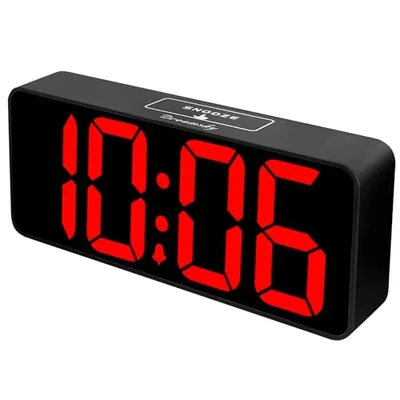
Start with the person, not the product
Buying a clock for yourself is a five-minute decision. Buying one for your mother is different: her eyes are twenty years older than yours, her nightstand is smaller than you remember, and the clock she has now was probably set by your father a decade ago. The failure mode is not a bad clock. It is a clock that quietly stops being used because a button confused her once.
So start with three questions. How far is the clock from the pillow, in feet? Does she wake at night and want to know the time without her glasses? And does the day of the week matter, is retirement dissolving Tuesday into Thursday, or is a calendar still on the wall and consulted?
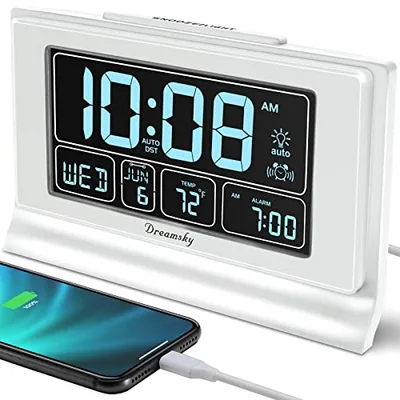

The answers sort every model we make into two piles: clocks about reading the time, and clocks about anchoring the day. The first pile is digit height. The second is a different product, and if you have never seen a day clock, the section on them below may be the most useful thing in this guide.
One more thing before the models: involve the parent if you possibly can. A clock that was chosen feels different from a clock that was issued, and a two-minute conversation about digit color or wood finish turns the same object from an aid into a possession. Where that conversation is no longer possible, choose the calmest option in each category, warm digits, fixed layout, fewest visible controls, and you will rarely be wrong.
Digit height decides the distance
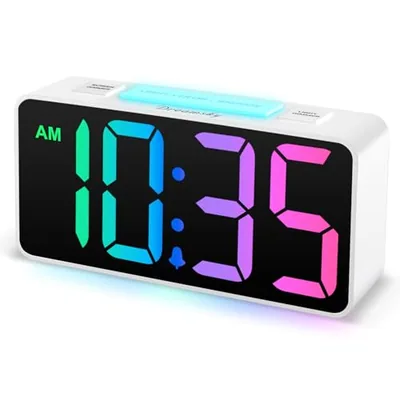
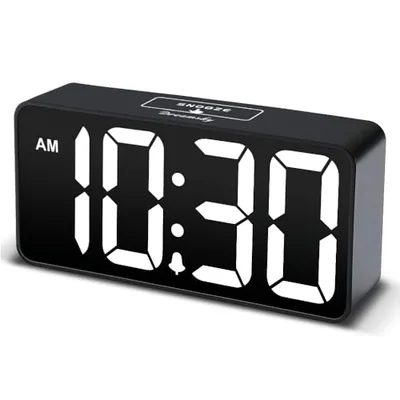
A digit reads comfortably at roughly one foot of distance per quarter inch of height for healthy eyes, and older eyes want a wide margin on top of that. In practice: the 2-inch digits on our small clock read from across a normal bedroom. The 9-inch large-display clock reads from down the hall.
That arithmetic is the reason the large-display clock exists. It is not a nightstand ornament: it is a wall-visible time source for someone who no longer wants to reach for glasses at 3 a.m. If your parent squints at their current clock from the bed, digit height is the fix, and no feature list changes that.
| Model | Digits | Shows day & date | Dimmer | From |
|---|---|---|---|---|
| Large Digital Alarm Clock, 9-Inch | n/s | No | Yes | $23.99 |
| Digital Calendar Day Clock | 7.6″ screen | Yes, spelled out | 4 levels | $25.49 |
| Large Calendar Day Clock | n/s | Yes, spelled out | Yes | $53.02 |
| Wooden Calendar Clock with Temperature | n/s | Yes, spelled out | Yes | $23.99 |
| Small Digital Alarm Clock | n/s | No | Yes | $14.99 |
| Auto-Set Alarm Clock, 5-Inch Display | 5″ screen | No | Yes | $25.99 |
Be honest about the trade: a 9-inch display needs a real spot on a dresser, a shelf or a wall bracket. On a narrow nightstand it looms. Measure the room before deciding, the way you would for a lamp.
There is a middle path that families overlook: the wooden 7-inch-class clocks and the compact calendar models sit between the two extremes, readable from four or five yards without dominating the furniture. If the room is small and the eyes are middling, the middle is usually right.
And test with the real eyes, not yours. Stand where the bed is, at night, lights off, and ask whether the time reads at a glance. Ten seconds of that beats any spec sheet, including ours.
Day clocks: when Tuesday needs anchoring
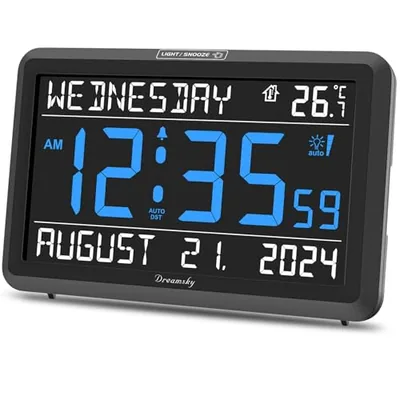
A calendar clock spells the day out in words: TUESDAY, then the date, then the time. For someone in early memory decline, that line answers the first question of every morning before it causes anxiety. It is a small thing that families consistently describe as the purchase that helped.
This is not our invention, and you do not have to take a manufacturer's word for it. The National Institute on Aging gives exactly this advice to people organizing their days after a dementia diagnosis, and the federal caregiving guidance leans on routine for the same reason.
Our calendar models keep the words large and the layout fixed: nothing cycles, nothing scrolls, the day does not share its line with anything else. Fixed layout matters more than beauty here, because a display that rearranges itself is a display that has to be re-learned.
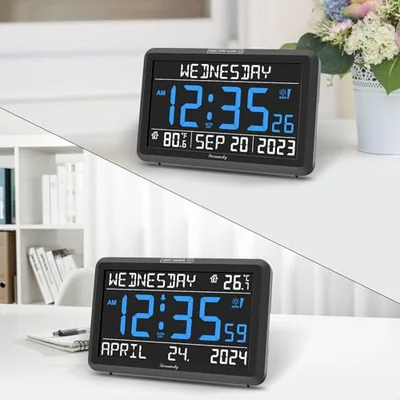
Where the clock goes matters nearly as much as which clock. Caregivers who live with these devices put them where the morning starts: facing the bed, or by the chair where coffee happens. A day clock in a hallway is decoration, a day clock at the point of waking is orientation.
Set expectations honestly, too. A day clock does not slow anyone's decline and does not replace human contact. What it does is subtract one small recurring confusion from the day, and in a long season of small losses, subtracting one reliably is worth the modest price.
«You may also want to consider using a digital clock that displays the day of the week and date, in addition to the time.»
National Institute on Aging, «Tips for Living Alone With Early-Stage Dementia», read 24 August 2026 · source
«Try to keep a routine, such as bathing, dressing, and eating at the same time each day.»
Alzheimers.gov, «Tips for Caregivers and Families of People With Dementia», read 24 August 2026 · source
Brightness: dim is a feature, dark is a bigger one
Aging eyes are slower to recover from light. A display that is comfortable at 8 p.m. can read like a headlight at 3 a.m., and the usual result is the clock gets turned to face the wall, which defeats the purchase.
Every clock in this guide has a stepped dimmer. The distinction worth checking on each product page is the bottom of the range: some models dim to fully dark and light on a button press, others hold a faint glow. For a parent who wants reassurance at a glance, faint glow is right. For a parent whose sleep is fragile, full dark wins.
Digit color plays a supporting role: at the same dimmer step, warm colors read dimmer than white or blue. If the bedroom is very dark, an amber or red display is the gentler night companion.
Buttons and setup: one function per control
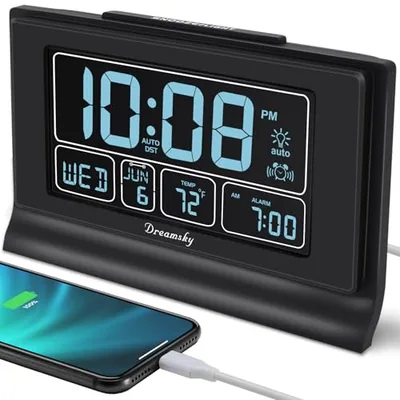
The best setup is the one that happens once. Our auto-set models arrive with the time preloaded, pick a time zone and the clock handles daylight saving itself. That removes the twice-a-year phone call, and after a power cut the backup battery keeps the settings so nothing has to be retaught.
Look at the alarm control specifically. On our clocks it is a dedicated switch, not a menu: on is on, off is off, and the state is visible. For arthritic hands, a physical slider beats any press-and-hold gesture.
One honest warning: basic models ring every day when the alarm is on. If your parent no longer needs a weekday wake-up, either leave the alarm off or pick a model with schedule control, the comparison table on the front page marks which ones can skip weekends.
Power, and what happens in an outage
Most of our clocks plug into the wall, and the batteries you add protect memory: through an outage they hold the time and the alarm setting, but the display sleeps. When power returns, the clock is simply right again, no blinking midnight, no reset ritual. For a senior household that is exactly the desired behavior.
The gap to know about: while the power is out, the display is off on those models. If your parent's area loses power often and the glow matters, look at the battery-operated exceptions or keep a battery lamp on the nightstand, do not expect a memory battery to light the room.
Whatever you choose, put fresh cells in on the day you set it up, and write the month on a sticker. A backup battery only backs up if someone remembered it exists.
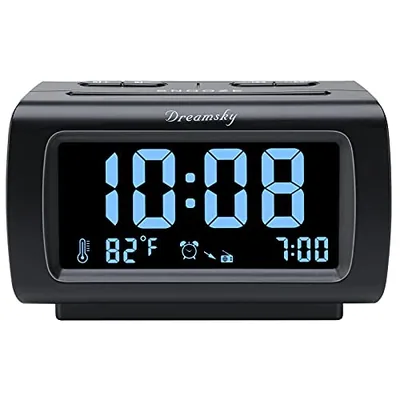
If you manage the household from a distance, the backup battery is quietly the most valuable line on the spec sheet. It is the difference between a phone call that starts with a blinking display and one that does not happen, because the clock never needed anything after the first day.
Cord placement is part of the same conversation: route it behind furniture, not across a walking line. A clock is a poor reason for a fall, and a taped or clipped cord costs nothing.
When the alarm has to actually wake someone
Hearing loss and deep sleep are their own problem, and volume knobs solve less of it than families hope. Our adjustable models go loud, genuinely loud, and ramp up rather than blasting, which wakes without frightening.
For someone a loud buzzer still does not reach, the honest answer is the vibrating clock: a rechargeable puck that goes under the pillow and shakes at up to five strengths. It wakes one person without waking the house, and hard-of-hearing buyers are its core audience.
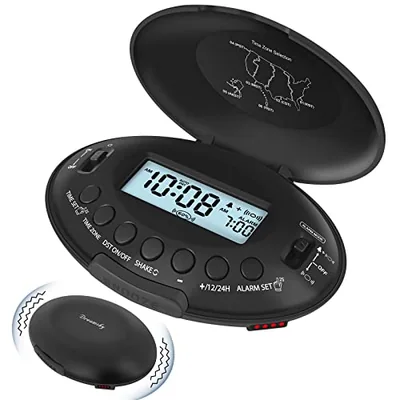
The wrong answer is bedside experimentation that ends with the alarm turned off entirely. Pick the wake method for the ears in question, and test it during an afternoon nap before trusting it with a morning.
A note on hearing aids: they come out at night, which is exactly when the alarm works. Families sometimes discover this only after two missed appointments. The pillow shaker sidesteps the whole issue, and its charge lasts long enough that topping it up once a week on the nightstand is routine rather than a chore.
If the bedroom should not look like electronics
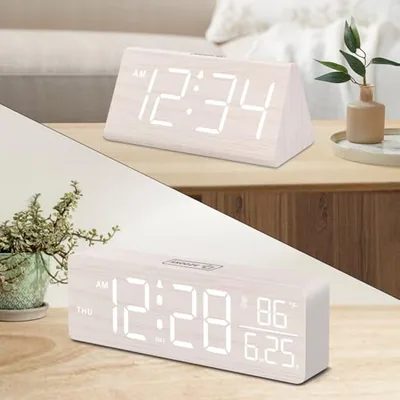
Some parents flatly refuse another gadget, and that is a design opinion worth respecting. The wooden clocks put the same large digits behind a wood-finish face: lit, the numbers float on the grain, dimmed, the whole thing reads as a small piece of furniture.
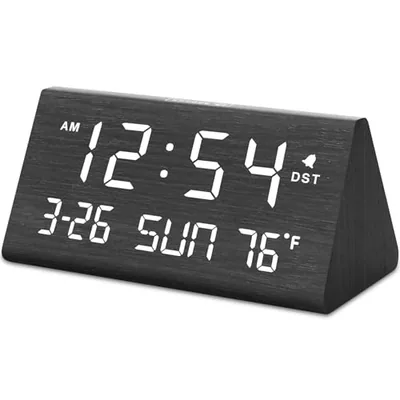
The finish is a wood-look veneer over the case, we say that plainly rather than implying solid timber. Versions differ by display: time only, day and date, or room temperature in the corner.
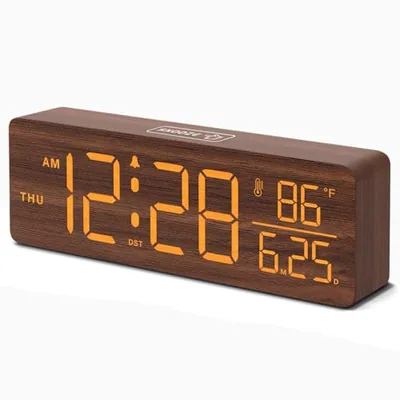
For a parent moving into assisted living, this is often the diplomatic choice: it does the calendar-clock job without announcing itself as an aid.
Pick the finish against the actual furniture, not from memory. Walnut beside oak reads as a mismatch every morning, when unsure, black wood-look sits quietly next to nearly everything.
Placing the clock: viewing angle, glare and the lamp
Digit height gets the attention, but placement decides whether the height works. LED digits wash out when a window or a lamp reflects off the display face, so the clock wants to sit at a slight angle to the brightest light in the room, not squarely opposite it. Two inches of repositioning often does more than two inches of digit.
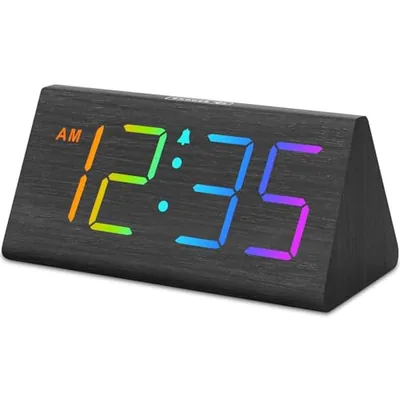
Height matters too. A display read from a pillow should sit near pillow height: on the nightstand, not on a tall dresser across the room, unless the digits are sized for that distance. For a chair-centered room, the same logic moves the clock to the shelf the chair faces.
Think about the night path as well. A parent who gets up at night walks a known route, and a faint display along that route is a landmark. Families who place the large clock where it is visible from the bathroom door report that the hallway stops being a guess.
None of this needs tools or planning beyond ten minutes with the box open. But it is the ten minutes that decides whether the clock is used for years or unplugged in a month.
Buying from far away: making the gift land
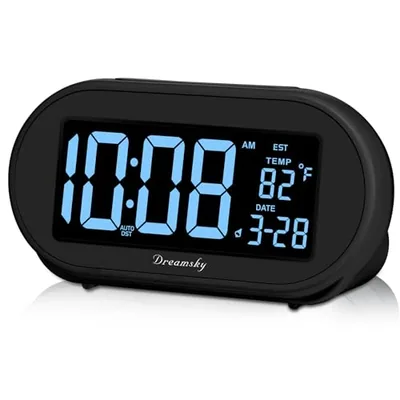
A lot of these clocks are bought by adult children in another city, and the distance changes the checklist. Order to your own address first, not theirs: set the zone, set or disable the alarm, load the batteries, and only then send or bring the clock over. An hour of your setup is the whole gift.
Write the essentials on a card in large print: how to switch the alarm, what the dimmer button does, and the one sentence that prevents the classic support call, which is that the display sleeps during a power cut and comes back right by itself. Tape the card under the clock or tuck it in the nightstand drawer.
If the parent lives in assisted living, tell the staff what the clock does, especially a day clock. Staff who know the display is trustworthy will point to it instead of answering the same question, which reinforces the habit of using it.
And keep the box for a week. Returns run under the policy of the shop that shipped it, and the one clock in ten that is wrong for the room goes back without drama, replaced by the model one size up or down.
The four mistakes families make, in order of frequency
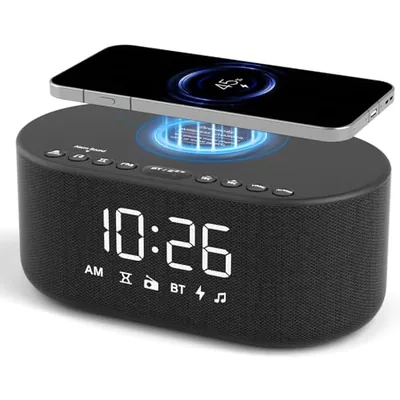
First: buying the feature list instead of the eyes. A clock with radio, Bluetooth and a charging pad is a fine bedside hub for the buyer, and a wall of small icons for an 80-year-old. If the person is not going to stream podcasts, every extra function is one more thing the wrong button can do. The plain models exist for this exact reason, and for seniors they are usually the premium choice.
Second: assuming the old clock is fine because it never broke. The question is not whether it works but whether it is being used, and squinting, leaning and asking someone else the time are the symptoms to look for. A working clock nobody can read has already failed.

Third: skipping the backup batteries because the clock is plugged in. The first storm resets a bare clock to a blinking midnight, and for someone who cannot re-set it, a blinking clock is worse than none: it shows a confident wrong time. Two AAA cells close that hole for a year or more.
Fourth: setting the alarm because a clock should have one. If nobody needs to wake at seven, an alarm that rings every day teaches the person to distrust the clock or to unplug it. Alarms are for schedules, a retired household often wants the display, the day line and nothing else.
None of these mistakes costs much to avoid, and all four are invisible in a product photo. That is why this guide keeps returning to the person: the clock is the easy half of the decision.
The five-minute checklist before you order

Measure the distance from pillow to clock spot, in feet, and match it against digit height, across the room needs 2 inches, down the hall needs 9. Ask whether day and date should be on the display, when in doubt for an older parent, they should.
Check the dimmer range on the product page for the model you picked, decide between faint-glow and full-dark, and pick a digit color on the warm side for dark bedrooms. Confirm the alarm control is a physical switch if hands are stiff.
Finally, set the clock up yourself before gifting it: zone picked, alarm set or off, batteries in, sticker dated. A clock that arrives working is a clock that gets used. Every model in this guide links to the shop that ships it, where ordering and returns are handled.